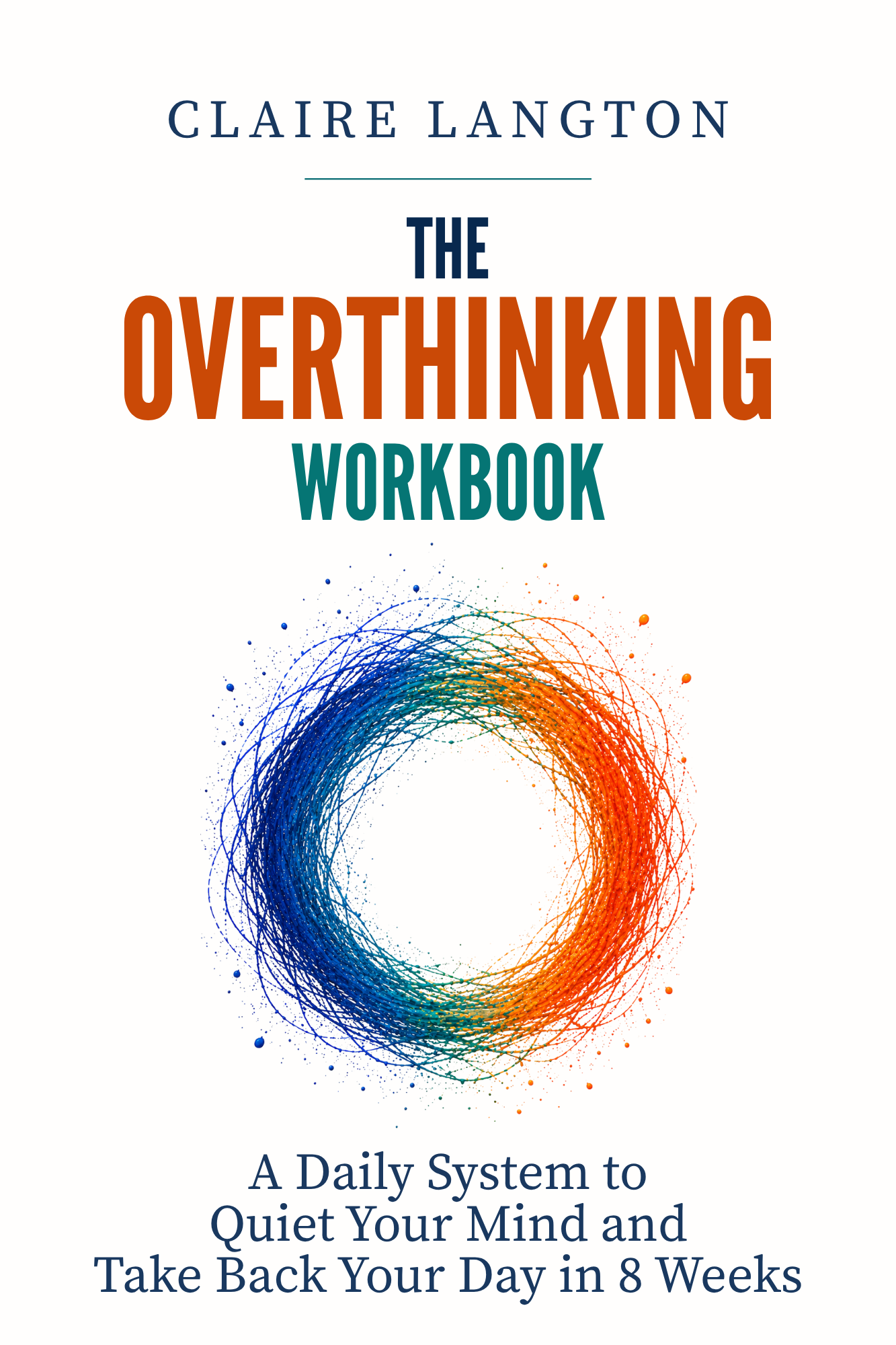
The problem
You don't have a knowledge problem. You have a system problem.
Most people who pick up a book about overthinking aren't in crisis. They're functional, often successful, and privately exhausted by a mind that won't stop processing. They replay conversations that ended hours ago. They rehearse conversations that may never happen. They revisit decisions long after they've been made.
You already understand the problem intellectually. You've read the explanations. What you're missing isn't insight. It's a structured daily practice that works in the middle of a Tuesday afternoon, at your desk, in an open-plan office, when a spiral starts and there's no time to meditate your way out of it.
The shift this book trains is metacognitive: not fewer thoughts, but a changed relationship to them. You learn to stand beside the loop and observe it, instead of sitting inside it looking for the exit.
Why the usual advice fails
A list of twenty-three techniques is not a system.
Every other book hands you a pile of tips and wishes you luck. But when a spiral hits, you can't recall twenty-three of them, let alone choose the right one. And the loop feels like work from the inside, which is exactly why it's so hard to drop: effort is not evidence of progress; a hamster sweats too. A mind that won't switch off doesn't need another tip. It needs an operating system: a small number of named tools, one clear question to tell thinking from spinning (wheel or corkscrew?), and a daily loop that runs on your own data.
Other books explain why you overthink. This one gives you the daily system to manage it.
The method
The Unwind Protocol
At the center of the book is one daily practice with four phases and thirteen named tools you'll actually reach for the moment a spiral starts. Catch the loop, break the loop, fill the space it leaves, learn from it.
The 8-week program
A progressive plan, not a pile of exercises
Parts 1 to 3 explain what overthinking actually is, why what you've tried didn't stick, and teach all thirteen tools. Part 4 is the program itself: eight weeks of progressive practice, from pure observation to advanced pattern management. It starts by watching, not fixing.
You don't walk it alone. Three readers recur throughout: Priya, whose work decisions circle for weeks; Gene, who wakes at 2 a.m. on the dot; and Tessa, who freezes at the fridge at the end of an ordinary day. You watch each of them fumble the tools, learn them, and make them their own.
Also inside
- The Overthinking Audit: measure your baseline, then your progress at Week 8
- Thirteen named tools you'll remember: the Thought Audit, Pattern Interrupt, Circuit Breaker, Two-Minute Review, and more
- The Minimal Viable System card: the whole protocol on one page, built to photograph and carry
- Weekly audits and a personalized protocol card
- Printable daily logs and worksheets built to be written in
- A Quick Start path if you need to handle a spiral right now
- Grounded in metacognitive-therapy research, in plain language
Is it for you?
This book is for you if…
- You function well but a big part of your mind is spent on repetitive, unproductive thinking
- You've tried other approaches and none stuck
- You want a system and evidence, not affirmations
- You're willing to write things down for a few minutes a day
It isn't the right tool if…
- You're in crisis or need urgent support (the book signposts where to turn)
- You want a quick affirmation rather than a daily practice
- You're looking for treatment for a clinical condition: this is a management system, not therapy
What changes
What's different after 8 weeks
You won't stop having thoughts. You'll stop treating every thought as an emergency.
- The spiral that runs for forty-five minutes now breaks in three, because you catch it starting and know exactly what to do next.
- The decision that's been circling for two weeks finally lands.
- The 2 a.m. replay still visits some nights, and you have a specific, practiced response for it, in the dark, without willpower.
- You have numbers: a baseline, a Week 8 score, and a log in your own handwriting showing spirals getting shorter and detection getting faster.
The protocol costs 15 to 20 minutes on a typical day. If overthinking currently costs you an hour, the system pays for itself from the first week. You're not adding a practice to a full life; you're buying back the hours the loops already take. No transformation is on offer. You finish with the same brain and better brakes. As one reader put it: I think the same amount. I suffer from it less.
Questions
Frequently asked
Is this therapy?
No. It's a practical, evidence-based system for managing the everyday habit of overthinking, not treatment for a clinical condition. The book is clear about the difference and signposts where to seek professional support if you need it.
How much time does it take?
The protocol runs in about 15 to 20 minutes on a typical day; the Overthinking Audit takes five. The eight-week program is designed to fit around a full, busy life, and to survive the days you miss.
Do I have to read it cover to cover?
No. There's a Quick Start for handling a spiral right now. But reading Parts 1 to 3 before you begin the program produces the best results: understanding why the tools work strengthens your judgment about when to use them.
What if I miss days?
The system is built for real life. Unlike a diet, it doesn't fail the moment you slip. The tools work whenever you use them, regardless of how long it's been.
How is this different from other overthinking books?
Most give you a list of techniques. This gives you a named daily system, the Unwind Protocol, with one clear question to tell thinking from spinning, an eight-week program, and weekly audits that run on your own data.
Take back your day.
The Overthinking Workbook is launching soon on Amazon in paperback, hardcover, and Kindle.
No spam. One email the day it goes live.